How the Louvre Is Organized: A Complete Breakdown of Its Wings and Departments

Charlotte Whitfield
18 May 2026
How the Louvre Is Organized: A Complete Breakdown of Its Wings and Departments
Introduction
The Louvre Museum in Paris is the largest art museum in the world, spanning over 72,000 square meters of exhibition space and housing more than 380,000 objects — of which roughly 35,000 are on display at any given time. For first-time visitors (and even returning ones), stepping through the iconic glass pyramid entrance can feel like entering a beautifully curated labyrinth.
The truth is, the Louvre wasn’t designed as a museum from the start. It evolved over centuries from a medieval fortress to a royal palace to the cultural institution we know today. That layered history is reflected in its complex layout — three interconnected wings, eight curatorial departments, and four floors of galleries that can leave even the most prepared traveler feeling disoriented.
But here’s the good news: once you understand how the Louvre is organized, everything clicks into place. This guide will give you a complete structural breakdown of the museum so you can plan a focused, efficient, and deeply rewarding visit — without wandering in circles.
The Three Wings of the Louvre
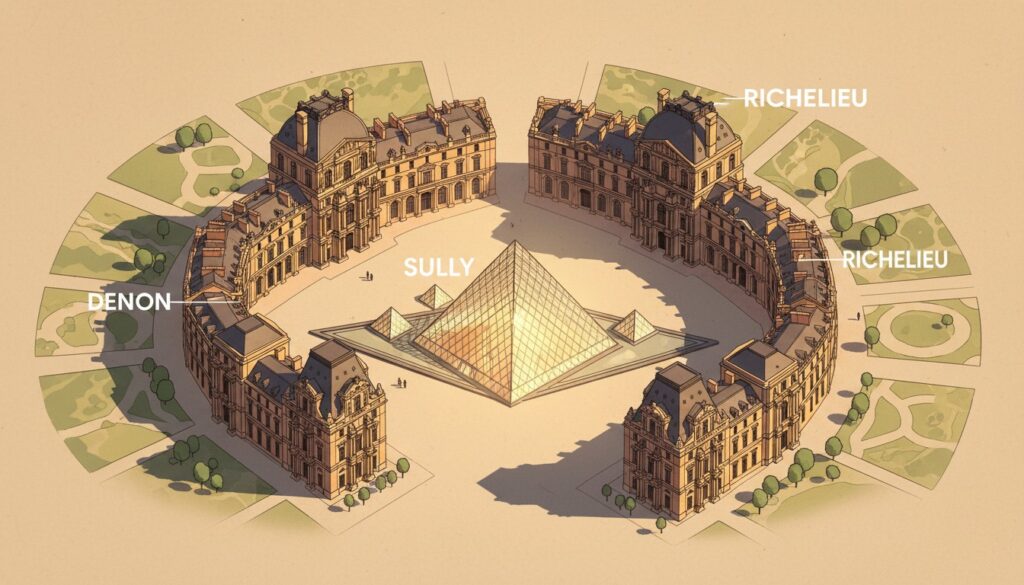
The Louvre is organized around a central axis — the Napoleon Courtyard and the famous I.M. Pei glass pyramid — from which three distinct wings radiate outward. Each wing has its own character, collections, and atmosphere.
Denon Wing (South)
The Denon Wing is by far the most visited section of the Louvre, and for good reason. It houses some of the museum’s most iconic masterpieces, including:
- The Mona Lisa by Leonardo da Vinci
- The Winged Victory of Samothrace (Nike of Samothrace)
- The Wedding at Cana by Veronese
- Large-format French paintings from the 19th century, including works by Delacroix and Géricault
- Italian and Spanish painting collections
- Greek and Roman antiquities
- The Venus de Milo (Aphrodite of Milos)
- Egyptian Antiquities — one of the world’s finest collections, spanning from the Nile civilization’s earliest days to the Roman period
- Near Eastern Antiquities — including artifacts from ancient Mesopotamia, Iran, and the Levant
- French painting from the 17th and 18th centuries
- Decorative arts and the lavishly restored Napoleon III Apartments (partially shared with Richelieu)
- The History of the Louvre exhibition in the medieval basement
- The Code of Hammurabi — one of the oldest known written legal codes
- The Winged Bulls of Khorsabad (Lamassu) — massive Assyrian guardian figures
- Northern European paintings, including masterworks by Vermeer, Rembrandt, and Rubens
- French sculpture displayed in the stunning glass-roofed Marly and Puget courtyards
- Napoleon III’s lavish apartments — ornately decorated state rooms that showcase Second Empire opulence
- Islamic Art galleries (partially located in the Denon Wing courtyard as well)
- Italian paintings → Denon Wing (including the Mona Lisa in the Salle des États)
- Spanish paintings → Denon Wing
- French paintings → Sully Wing and Richelieu Wing
- Northern European paintings (Dutch, Flemish, German) → Richelieu Wing
- British paintings → Denon Wing
- Ancient civilizations enthusiast? → Egyptian and Near Eastern galleries in Sully and Richelieu
- Renaissance art lover? → Italian paintings in Denon plus sculpture in the Denon lower galleries
- French history buff? → Napoleon III Apartments in Richelieu, Crown Jewels in Apollo Gallery (Sully/Denon), and French paintings in Sully
- Crowd-averse explorer? → Start in Richelieu, then move to Sully, and finish in Denon
- Carrousel du Louvre (underground shopping mall entrance via Rue de Rivoli)
- Passage Richelieu (for visitors with pre-purchased tickets)
- Porte des Lions (Denon Wing, when open — check availability)
- Wednesday and Friday evenings (open until 9:45 PM) are significantly less crowded
- Monday and Thursday tend to be the busiest days
- The museum is closed on Tuesdays
- First Saturday of each month offers free evening admission (6 PM–9:45 PM) — expect large crowds
- The Medieval Moat (Sully Wing, Lower Ground Floor)
- The Marly Courtyard (Richelieu Wing, Ground Floor)
- The Egyptian Crypt of the Sphinx (Sully Wing)
- The Galerie d’Apollon with the Crown Jewels (Denon/Sully junction)
- Vermeer’s “The Lacemaker” (Richelieu Wing, Second Floor)
Pro Tip: If you only have 2–3 hours at the Louvre, the Denon Wing should be your primary focus. Arrive early or visit on a Wednesday or Friday evening (when the museum stays open late) to avoid the worst crowds around the Mona Lisa.
The Denon Wing is named after Vivant Denon, the museum’s first director, appointed by Napoleon in 1802. It stretches along the Seine river and connects to the Sully Wing at its eastern end.
Sully Wing (East)
The Sully Wing is built around the oldest part of the Louvre — the medieval foundations of the original fortress constructed by King Philip II (Philippe Auguste) in the late 12th century. Visitors can actually descend to the lower level to explore the remnants of the medieval moat and keep, which is a fascinating experience in itself.
Key highlights of the Sully Wing include:
Pro Tip: The Sully Wing tends to be less crowded than Denon, especially on the upper floors. If you love ancient civilizations, you could easily spend half a day here exploring the Egyptian and Near Eastern galleries alone.
Richelieu Wing (North)
The Richelieu Wing is the newest addition to the museum’s exhibition space, having been converted from the French Ministry of Finance offices in 1993 as part of the Grand Louvre renovation project. It is often the least crowded of the three wings, making it a favorite among seasoned visitors.
Highlights of the Richelieu Wing include:
Pro Tip: Start your visit in the Richelieu Wing if you want to beat the crowds. Most visitors rush straight to the Denon Wing for the Mona Lisa, leaving Richelieu blissfully quiet during the first hour of opening.
The Eight Curatorial Departments
Beyond its physical wings, the Louvre organizes its collections into eight curatorial departments, each managed by specialized teams of curators, conservators, and researchers. Understanding these departments helps you locate specific types of art and artifacts across the museum’s sprawling layout.
1. Egyptian Antiquities
Location: Sully Wing, Ground Floor and First Floor
This department covers over 50,000 objects spanning more than 5,000 years of Egyptian civilization. Highlights include royal sarcophagi, the Great Sphinx of Tanis, papyrus scrolls, jewelry, and everyday objects that paint a vivid picture of life along the Nile.
2. Near Eastern Antiquities
Location: Sully Wing (Ground Floor) and Richelieu Wing (Ground Floor)
This department covers ancient civilizations from Mesopotamia, Iran, and the Levant — including Sumerian, Babylonian, Assyrian, and Phoenician cultures. The monumental Lamassu sculptures and the Code of Hammurabi are the crown jewels of this collection.
3. Greek, Etruscan, and Roman Antiquities
Location: Denon Wing (Ground Floor and First Floor) and Sully Wing (Ground Floor)
Home to the Venus de Milo and the Winged Victory of Samothrace, this department spans classical antiquity from the Bronze Age through the decline of the Roman Empire. The collection includes sculpture, pottery, bronzes, jewelry, and mosaics.
4. Islamic Art
Location: Denon Wing, Lower Ground Floor (Visconti Courtyard)
The newest department, inaugurated in 2012, is housed beneath a stunning undulating glass-and-metal roof in the Visconti Courtyard. It showcases over 18,000 objects from across the Islamic world, spanning from the 7th to the 19th century — including ceramics, textiles, metalwork, miniatures, and architectural elements.
5. Paintings
Location: Spread across all three wings
The Louvre’s painting collection is one of the most comprehensive in the world, with over 7,500 works ranging from the 13th to the mid-19th century. The collection is organized geographically:
6. Sculpture
Location: Denon Wing (Italian and Spanish) and Richelieu Wing (French and Northern European)
The sculpture department spans from the early Middle Ages to the mid-19th century. The Marly and Puget courtyards in the Richelieu Wing — with their soaring glass ceilings and garden-like atmosphere — are among the most breathtaking spaces in the entire museum.
7. Decorative Arts
Location: Richelieu Wing and Sully Wing (First Floor)
This department covers an enormous range of objects — furniture, tapestries, ceramics, goldsmith work, glassware, and more — from the Middle Ages to the mid-19th century. The Apollo Gallery, home to the French Crown Jewels including the famous Regent Diamond, is a must-see.
8. Prints and Drawings
Location: Rotating exhibitions (Sully Wing, Second Floor)
With over 200,000 works on paper, this is one of the largest graphic arts collections in the world. Due to the fragility of works on paper, only a small selection is displayed at any given time through rotating exhibitions. The collection includes drawings by Leonardo da Vinci, Dürer, Rembrandt, and countless others.
Navigating the Floors
The Louvre uses a European floor numbering system, which can confuse visitors from North America:
| Louvre Floor Name | Equivalent (US) | What You’ll Find |
|—|—|—|
| Lower Ground Floor (-2, -1) | Basement levels | Medieval Louvre, Islamic Art, History of the Louvre |
| Ground Floor (0) | First Floor | Egyptian, Near Eastern, Greek/Roman Antiquities, Sculpture |
| First Floor (1) | Second Floor | Paintings (including Mona Lisa), Decorative Arts, Crown Jewels |
| Second Floor (2) | Third Floor | French and Northern European Paintings, Prints and Drawings |
Important: Not all wings have the same number of accessible floors. The Denon Wing, for example, has fewer galleries on the second floor compared to the Sully and Richelieu Wings. Always grab a free floor plan at the information desk beneath the pyramid or download the official Louvre app before your visit.
Practical Tips for Planning Your Visit by Layout
Understanding the layout is only half the battle. Here are some actionable strategies for making the most of the Louvre’s organization:
Choose a Theme, Not a Route
Instead of trying to “see everything” (which is physically impossible in one visit), pick a thematic focus:
Use the Underground Entrances
The pyramid entrance is iconic but often has the longest lines. Consider entering through:
Time Your Visit Strategically
Don’t Skip the Overlooked Gems
While everyone rushes to the Mona Lisa, some of the Louvre’s most extraordinary experiences are tucked away in quieter corners:
Conclusion
The Louvre’s organization — three wings, eight departments, four floors — may seem complex at first glance, but it follows a logical structure rooted in geography, chronology, and medium. The Denon Wing draws the biggest crowds with its Italian masterpieces and classical antiquities. The Sully Wing offers a deep dive into ancient Egypt and the medieval origins of the building itself. And the Richelieu Wing rewards patient visitors with Northern European art, spectacular courtyards, and a sense of peaceful discovery.
By understanding this structure before you arrive, you transform your visit from a stressful sprint into a curated, meaningful experience. You’ll spend less time staring at maps and more time standing in awe before works of art that have shaped human civilization.
Remember: You don’t need to see everything in one visit. The Louvre has been here for over 230 years as a public museum — it will be here when you come back.
Plan Your Perfect Louvre Visit
Ready to put this knowledge into action? Download the official Louvre museum map, bookmark this guide for reference, and start building your personalized itinerary based on the wings and departments that excite you most. If you found this layout breakdown helpful, explore our other guides on the best Louvre itineraries by time, skip-the-line ticket strategies, and hidden gems most tourists miss.
Have you visited the Louvre? Which wing was your favorite? Share your experience in the comments below!